"For with God nothing shall be impossible"
Luke 1:37
Luke 1:37
Impulsive Actions
Impulsive actions are actions that happen literally before one reasons about the consequences of the action. The impulsive pathway in the brain is faster than the reasoning pathway in the brain. When an impulse happens one acts before the idea has been taken fully through the cortex of the brain to reason and judge the action.1
Cindi, who is nonverbal, discusses this challenge:
Cindi, who is nonverbal, discusses this challenge:
|
|
Impulses are not about knowing right from wrong, but acting before one considers what is right or wrong. Some impulses are anxiety related, some pleasure driven. In both cases, they need to learn to reason before they act. Others have developed bad habits and lash out in anger (please note that the large majority of individuals will not hurt you, and those that do often feel horrible about it and themselves). Some impulses are related to sensory processing issues.
You might manifest impulsive actions when you go shopping. You might purchase something that looks great that moment. Then you leave the store and ask yourself why in the world you bought it.
For these individuals, it usually looks more extreme. It might look like:
You might manifest impulsive actions when you go shopping. You might purchase something that looks great that moment. Then you leave the store and ask yourself why in the world you bought it.
For these individuals, it usually looks more extreme. It might look like:
|
|
Ideas to help:
1-Teach the individual and have them reason about it and learn about the consequences to themselves and others. Do so without becoming emotional. Keeping calm, but clear helps productive conversations happen. (During the moment only help them realize what they are doing- as talking about why can make it worse. When they have calmed down, in some cases you can problem solve.)2
2-Work with the individual with an impulsive action as a team. By helping working with them, it makes for a better affect and more effort to overcome the challenge. Work together with the individual respectfully instead of constantly reprimanding them without giving them tools to improve. By having a straight forward, but kind conversation, you become a team and then it is easier to solve problems. Let them know you will be with them through the ups and downs of trying to over come the impulse.
3-As with sensory challenges, find a replacement action that could serve the same or similar purpose, whether that be something else to grab or bite or an way to communicate a need for a drink. Even make sure a individual is given a drink when they first get to class or church if the issue is thirst (and not an obsession where it is pleasurable over a need.)3
1-Teach the individual and have them reason about it and learn about the consequences to themselves and others. Do so without becoming emotional. Keeping calm, but clear helps productive conversations happen. (During the moment only help them realize what they are doing- as talking about why can make it worse. When they have calmed down, in some cases you can problem solve.)2
2-Work with the individual with an impulsive action as a team. By helping working with them, it makes for a better affect and more effort to overcome the challenge. Work together with the individual respectfully instead of constantly reprimanding them without giving them tools to improve. By having a straight forward, but kind conversation, you become a team and then it is easier to solve problems. Let them know you will be with them through the ups and downs of trying to over come the impulse.
3-As with sensory challenges, find a replacement action that could serve the same or similar purpose, whether that be something else to grab or bite or an way to communicate a need for a drink. Even make sure a individual is given a drink when they first get to class or church if the issue is thirst (and not an obsession where it is pleasurable over a need.)3

|
For example, say an individual bites their arm. You can use options and help them reason, (the bold words are the options you could give the individual to choose from): "Did you BITE your arm or TICKLE yourself? And biting your harm will HELP or HURT your arm even if you don't feel pain? Do you see how your arm is starting to become rough? YES or NO? That is because your arm is building a callus to protect your arm. Do you think it looks good on your arm? YES or NO? It is good that God created our amazing bodies to be able to defend itself, but let's see if we can work on not biting ourselves. Do you think we could try something to bite instead of your arm? YES or NO? How about this chewy tube..."
|
4-It is not ok for an individual to harm another. When circumstances prevent an individual from attending church, it is important to reach out to them and the individual with the impulsive actions. By working with the family, individual, leaders, and congregation members, much good can be done to spiritually nourish and help them be participating members.
5-Wear long sleeves or don't stay next to the individual for long amounts of time if the reason for this is tactile. For a some individuals, skin or a physical person can trigger the impulses. By covering your arms you help remove the trigger. By going in and out of the individuals space to help them or give them options, you help them build up the tolerance to being physically close to someone without it being too much.
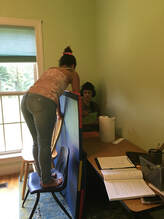
|
While this position isn't conducive for a church environment, this individual behind the wall, who is very kind hearted and hard working, was having a rough day (not typical as he is very gentle and safe to be around). His sister, and teacher, didn't give up on him. Instead she kept her self safe and continued to teach. As he wasn't out to get her (meaning there was a physical barrier, but he could have easily knocked it down has he been anxious or out to get her), the visual barricade worked and he was able to stay and finish his lessons. This kind of dedication and love is an example of the attitude we can have as we go about serving individuals with impulsive actions.
|
6-Ask yourself, "What would Jesus do?" How would he show love to the individual, but teach them. How would he treat the family who are likely hypersensitive to what their child is doing? How would he treat the individual doing it, who may be horrified by what they do? How would he work with others to find solutions? Go to the Lord in prayer for the individual, family, and congregation.4 Go to the lord in prayer to fill you with love. "For with God nothing shall be impossible." (Luke 1:37)
7-When having a student answer questions remind them to slow down and self regulate so they can more easily show their knowledge. More information on this can be found in the teaching section of the website.
8-Where possible, get them thinking about something else (distract), like answer about factual information from a lesson. Have them do something else with their hands.5
9-Talking to an individual (and not about them) like they understand. You never know what emotions and actions have developed over the years because an individual feel so misunderstood or so hopeless to overcome that they have given up trying. When you treat them differently than they ever have been treated. When you seek them out to be there for them, and are patient as they try to overcome. When they see you won't give up, some find more strength to try again and you might see changes--some small, some drastic.
10-Be patient with yourself and believe in yourself. Remember, for many of you, this is a huge learning curve. Feeling inadequate is normal, even for professionals. It is ok, if you mess up and mess up a lot. It is ok to be learning. Sometimes, not being a professional in this area will give the situation a fresh set of eyes and willingness to learn. You might be exactly what that child and families needs--even with all your flaws and inexperience.
|
"REALLY THINK IMPULSES ARE HARD TO TALK ABOUT. BECAUSE IT IS REALLY MOSTLY MY FA(u)LT, BUT I CAN'T HELP IT." -Ryan, Age 12, Texas |
|
References:
1-Mukhopadhyay, S. (2008) Understanding Autism Through Rapid Prompting Method. (Pg. 59), Denver: Outskirts Press, Inc.
2-Mukhopadhyay, S. (2008) Understanding Autism Through Rapid Prompting Method. (Pg. 77-79), Denver: Outskirts Press, Inc.
3-Browder, D.M. (2001). Curriculum and Assessment for Students with Moderate and Severe Disabilities. (Pg. 330-331). New York: Guilford Publications, Inc.
4- Matthew 7:7 from the New Testament
5-Mukhopadhyay, S. (2008) Understanding Autism Through Rapid Prompting Method. (Pg. 77-79, 150), Denver: Outskirts Press, Inc.
2-Mukhopadhyay, S. (2008) Understanding Autism Through Rapid Prompting Method. (Pg. 77-79), Denver: Outskirts Press, Inc.
3-Browder, D.M. (2001). Curriculum and Assessment for Students with Moderate and Severe Disabilities. (Pg. 330-331). New York: Guilford Publications, Inc.
4- Matthew 7:7 from the New Testament
5-Mukhopadhyay, S. (2008) Understanding Autism Through Rapid Prompting Method. (Pg. 77-79, 150), Denver: Outskirts Press, Inc.